Legal reasoning
Think it through with a second mind.
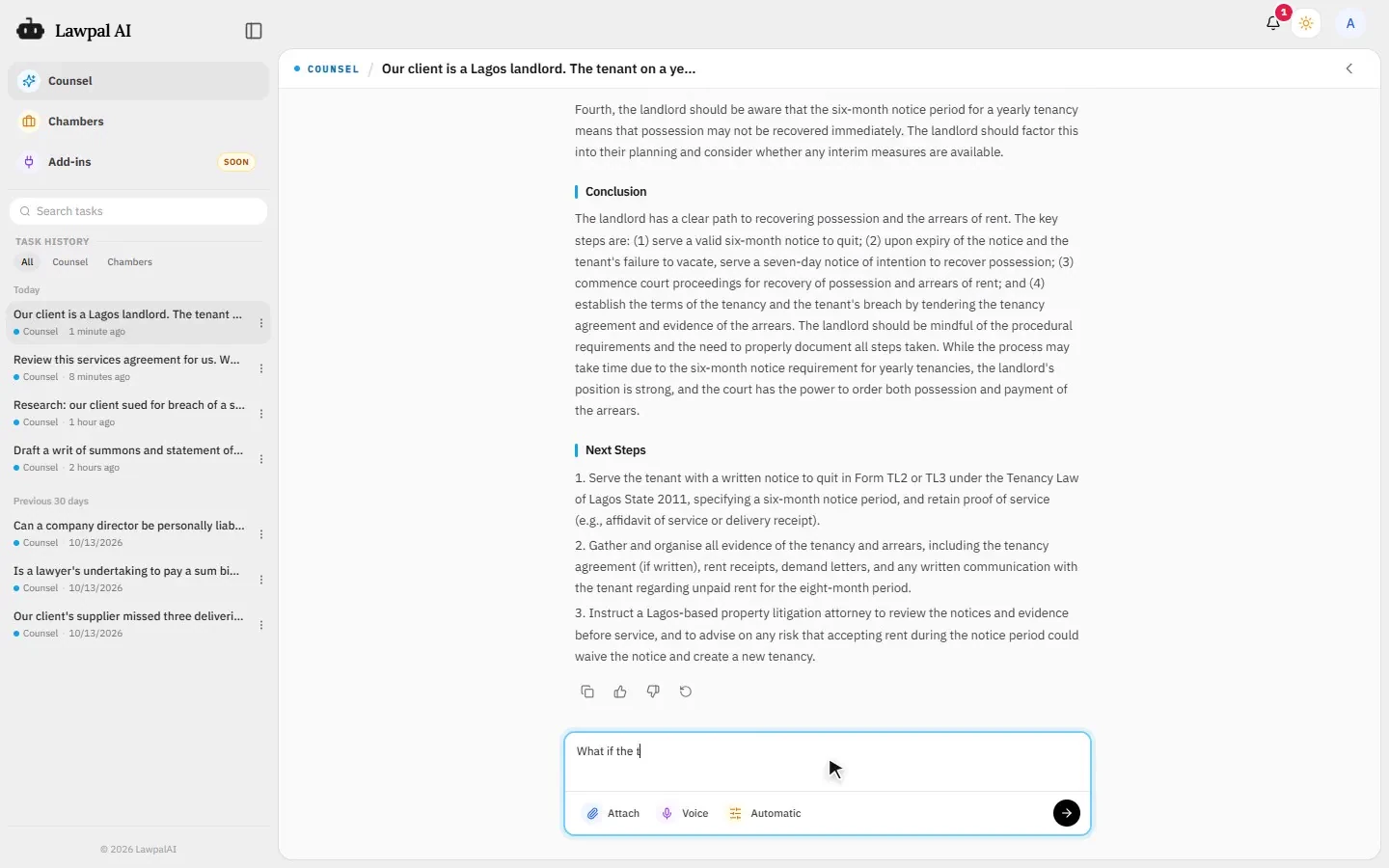
Bring the facts. Counsel sets out the governing principle, applies it to your client's position, and lays out the options and the next steps.
Ask CounselLive · 4× speed
A client's problem reasoned through, from the facts to the next steps.
How it works
From facts to a way forward.
Structured the way you would reason it yourself — principle, application, options.
01
Bring the facts
Tell Counsel what happened, who your client is, and what they want. Add documents if you have them.CounselMy client was dismissed after nine years with a private company. No hearing, and the letter gives no reason. What are her options?02
The governing principle
First the rule that decides the question, stated plainly, with where it comes from.Legal reasoningThe principle
In a private employment governed only by contract, the employer may generally end it on the notice the contract requires, without giving a reason.
Where the contract or staff handbook sets a disciplinary procedure, dismissal for misconduct must follow it — including giving the employee a chance to be heard.
03
Applied to your client
Then the rule applied to the facts you gave — what helps her, what doesn't, and what is still unknown.Legal reasoningApplied
If her contract or handbook provides a disciplinary procedure and it wasn't followed, the dismissal may be wrongful.
If it doesn't, her claim is likely limited to the notice pay and the entitlements her contract gives.
Still to find out: whether she was dismissed or her employment was terminated, and what the contract says about notice.
04
Options and next steps
It ends with what you can do, in order, so the conversation turns into a plan.Legal reasoningNext steps
- Get the contract, the staff handbook and the dismissal letter.
- Write to the employer for her outstanding entitlements and the reason for dismissal.
- If that fails, consider a claim at the National Industrial Court, which hears employment disputes.
Where it reasons
Across the questions clients bring.
Employment
Wrongful dismissal
Tenancy
Recovery of premises
Property
Title to land
Corporate
Shareholder disputes
Commercial
Breach of contract
Banking
Loan default
Succession
Letters of administration
Family
Custody and maintenance
Human rights
Fundamental rights
Arbitration
Enforcing an award
Tax
Tax assessments
Intellectual property
Trademark infringement
Questions
Questions lawyers ask first.
- Does it replace my judgment?
- No. It's a second mind to test your thinking against. The advice your client receives is yours.
- Can I ask follow-up questions?
- Yes. The conversation keeps the facts you've given, so you can push on any point without starting again.
- Can it work from my matter?
- Yes, if you use Chambers. Counsel can work from the matter's court record, diary and tasks instead of you retyping them.
- Is what I tell it kept private?
- We don't use your content to train AI models, and it's encrypted in transit and at rest.
Bring the hard question.
Ask Counsel